Mass Spectrometry and Metabolomics Core
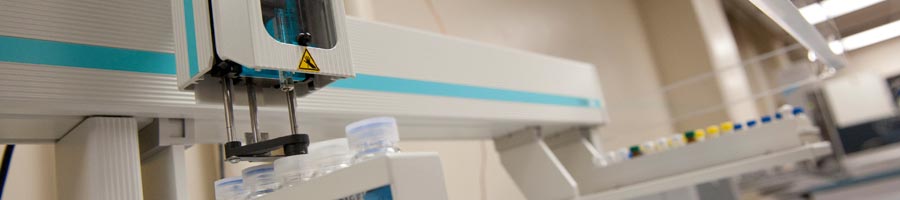
The Mass Spectrometry and Metabolomics Core is an open access resource where researchers and facility staff perform small molecule, macromolecule, and metabolomic analyses using 11 mass spectrometers. The Core is located in 3400 sq. ft. of laboratory space (newly renovated in 2023) in the basement of the Biochemistry Building (Rooms 11, 15, 17). Core staff provide training in experiment design, theory and operation of instruments, method development, and data interpretation. Trained instrument users enjoy 24/7 open access for instrument use and hourly or per-sample fees are charged based on the instrument. The facility houses three GC/MS systems: one single quadrupole GC/MS (Agilent 5975C, equipped with a CTC PAL autosampler as well as a Teledyne AtomX XYZ purge-and-trap accessory), one triple quadrupole GC/MS/MS instrument (Agilent 7010B equipped with a CTC PAL autosampler and capabilities for headspace analysis and a Chromtech TDAS 2000 system for thermal desorption analysis) and one GC-Time-Of-Flight MS (Leco GC-HRT+) capable of providing accurate mass measurements. There are a total of 7 LC/MS/MS instruments: four triple quadrupole LC/MS/MS systems (Waters Xevo TQ-XS, Xevo TQ-S micro, Xevo TQ-S, and Acquity TQ-D), one Thermo Q-Exactive LC/MS/MS, and two Waters Xevo G2-XS QTof LC/MS/MS systems. The core also houses a Bruker ultrafleXtreme MALDI-TOF/TOF with imaging capabilities and an HTX M3+ sprayer for MALDI imaging sample prep. A Waters eλ photodiode array detector is configured on one of the QTof LC/MS/MS instruments. All mass spectrometers are equipped with autosamplers, and all of the LC/MS instruments are interfaced to UHPLC pumps. Untargeted processing of LC/MS data is achieved using Waters Progenesis QI and Thermo Compound Discoverer software, and Agilent Profiler and MassProfiler Professional (MPP) software is used for untargeted analysis of GC/MS data. Software for MALDI data analysis includes SCiLS Lab (imaging data) and PolyTools (polymer data). Data files are archived nightly to a 50 TB RAID 6 NAS archive.
Equipment
LC/MS/MS (tandem quadrupole)
- Waters TQ-D UPLC/MS/MS
- Waters Xevo TQ-S UPLC/MS/MS
- Waters Xevo TQ-XS UPLC/MS/MS
- Waters Xevo TQ-S Micro UPLC/MS/MS
LC/MS/MS (High Mass Resolution Systems)
- Quadrupole/Time-of-Flight systems
- Waters Xevo G2-XS UPLC/MS/MS (2 instruments)
- Quadrupole/Orbitrap system
- Thermo Q-Exactive UPLC/MS/MS
GC/MS
- Agilent 5975 GC/single quadrupole MS
- Agilent 7010 GC/triple quadrupole MS/MS
- Leco GC-HRT+ GC/Time-of-Flight MS
MALDI-TOF
- Bruker ultrafleXtreme MALDI-TOF/TOF with imaging capabilities
- HTX M3+ matrix sprayer
Submission
The Core is, if time allows, accessible to academic investigators from any institution. Samples will be accepted provided they are appropriate for current Core capabilities. Access is also granted to occasional industrial clients on a time-available basis. Prior to sending samples, investigators are recommended to contact the Core staff to discuss the required analysis. This is necessary to insure that the most efficient and cost-effective analytical methods are employed. Samples are normally analyzed in the order of their receipt, but special arrangements can be made for unstable samples. A sample submission form should accompany each set of samples. The information requested on this form should be filled out completely to assure that the analyses can be carried out properly. Missing information from the form (e.g., sample solubility, stability, molecular formula, if known) will result in delays in the requested analyses.